

Eagle Scouts
The Eagle Scout Award, the highest award in Scouting America, has been awarded to young adults for more than 100 years. Since 1912, approximately 4 percent of youth who were Scouts have earned the award, totaling more than 2.75 million young adults who have achieved the rank of Eagle Scout.
Over the years, requirements for the Eagle Scout Award have changed to meet the needs of the time; however, certain elements of the program have remained true from the original Eagle Scout requirements. A Scout must demonstrate citizenship and caring for his community and others, leadership qualities and outdoor skills that show their self-sufficiency and ability to overcome obstacles. Today, a Scout must earn a total of 21 merit badges (10 more than required for the Life rank), including these 13 merit badges:
(a) First Aid, (b) Citizenship in the Community, (c) Citizenship in the Nation, (d) Citizenship in the World, (e) Communication, (f) Cooking, (g) Personal Fitness, (h) Emergency Preparedness OR Lifesaving, (i) Environmental Science OR Sustainability, (j) Personal Management, (k) Swimming OR Hiking OR Cycling, (l) Camping, and (m) Family Life.
Beyond the merit badges, an Eagle Scout candidate must also plan and carry out a service project to benefit the community. In addition, they must have held a troop leadership position during their Scouting tenure. Finally, each Eagle Scout candidate undergoes a rigorous review in which his district, council and troop leaders evaluate their “attitude and practice of the ideals of Scouting.” Achieving the rank of Eagle Scout must happen before a Scout’s 18th birthday.

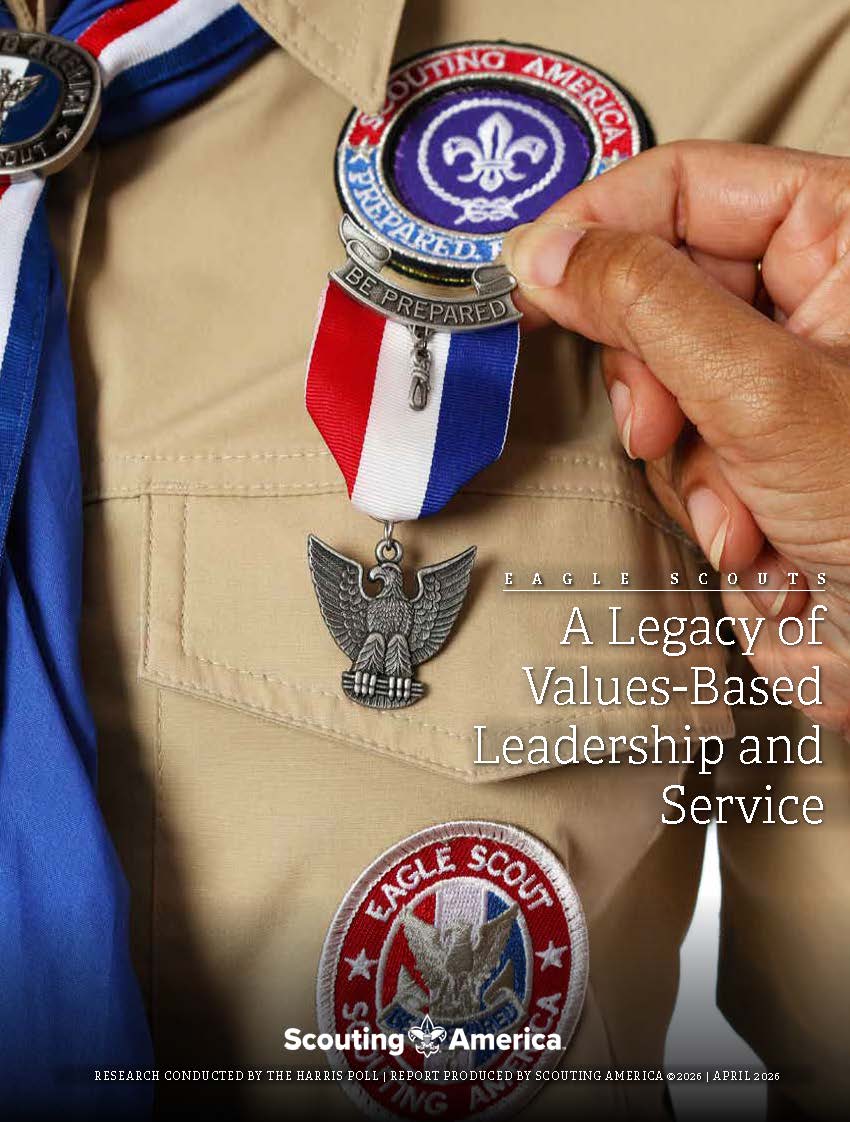
Eagle Scouts: A Legacy of Values-Based Leadership and Service
Research conducted by The Harris Poll
Report produced by Scouting America, April 2026
Through the Scouting program, Eagle Scouts build character and lifelong strengths that set them apart. To better understand these advantages, Scouting America partnered with The Harris Poll to survey thousands of adults and study how Eagle Scouts compare to people who have not participated in Scouting. Here is what the results of that research show:
-
- Eagle Scouts feel happier and more hopeful than peers who were never Scouts.
- Scouting encourages an active, outdoor lifestyle. Eagle Scouts tend to choose healthier activities.
- Scouting teaches young people to step up and speak out. As adults, Eagle Scouts are far more likely to lead at work and in their communities.
- Eagle Scouts live by strong personal values. They are more likely to be trustworthy, helpful, and willing to do the right thing.
In summary, when compared to Scouts and non-Scouts, Eagle Scouts exhibit significantly higher levels of health and recreation, connection, service and leadership, environmental stewardship, goal orientation, planning and preparedness and character.
Download the Eagle Scout Study (.pdf) or visit the Scouting America interactive website

Eagle Scouts: Merit Beyond the Badge
By Sung Joon Jang, Byron R. Johnson and Young-II Kim
Baylor University, October 2010
This nationally representative survey revealed significant differences between Eagle Scouts and other Scouts as well as non-Scouts. Eagle Scouts consistently indicate their experience in Scouting contributed to positive and prosocial development as measured by responses to a wide range of issues and subjects, including the following:
-
- Eagle Scouts exhibit an increased tendency to participate in a variety of health and recreational activities.
- Eagle Scouts show a greater connectedness to siblings, neighbors, religious community, friends, co-workers, formal and informal groups and a spiritual presence in nature.
- Duty to God, service to others, service to the community and leadership are traits that are especially strong in Eagle Scouts.
- Eagle Scouts are more likely to engage in behaviors that are designed to enhance and protect the environment.
- Eagle Scouts are more likely to be committed to setting and achieving personal, professional, spiritual and financial goals.
- Eagle Scouts show higher levels of planning and preparedness than do other Scouts and non-Scouts.
- Eagle Scouts are more likely than other Scouts and non-Scouts to indicate they have built character traits related to work ethics, morality, tolerance and respect for others.
In summary, when compared to Scouts and non-Scouts, Eagle Scouts exhibit significantly higher levels of health and recreation, connection, service and leadership, environmental stewardship, goal orientation, planning and preparedness and character.
